Cosmic Echoes: Mapping the Early Universe's Gravitational Waves
Advanced interferometry arrays pick up background ripples left over from expansion inflation phases, giving physicists an unshielded glimpse into historical creation windows.
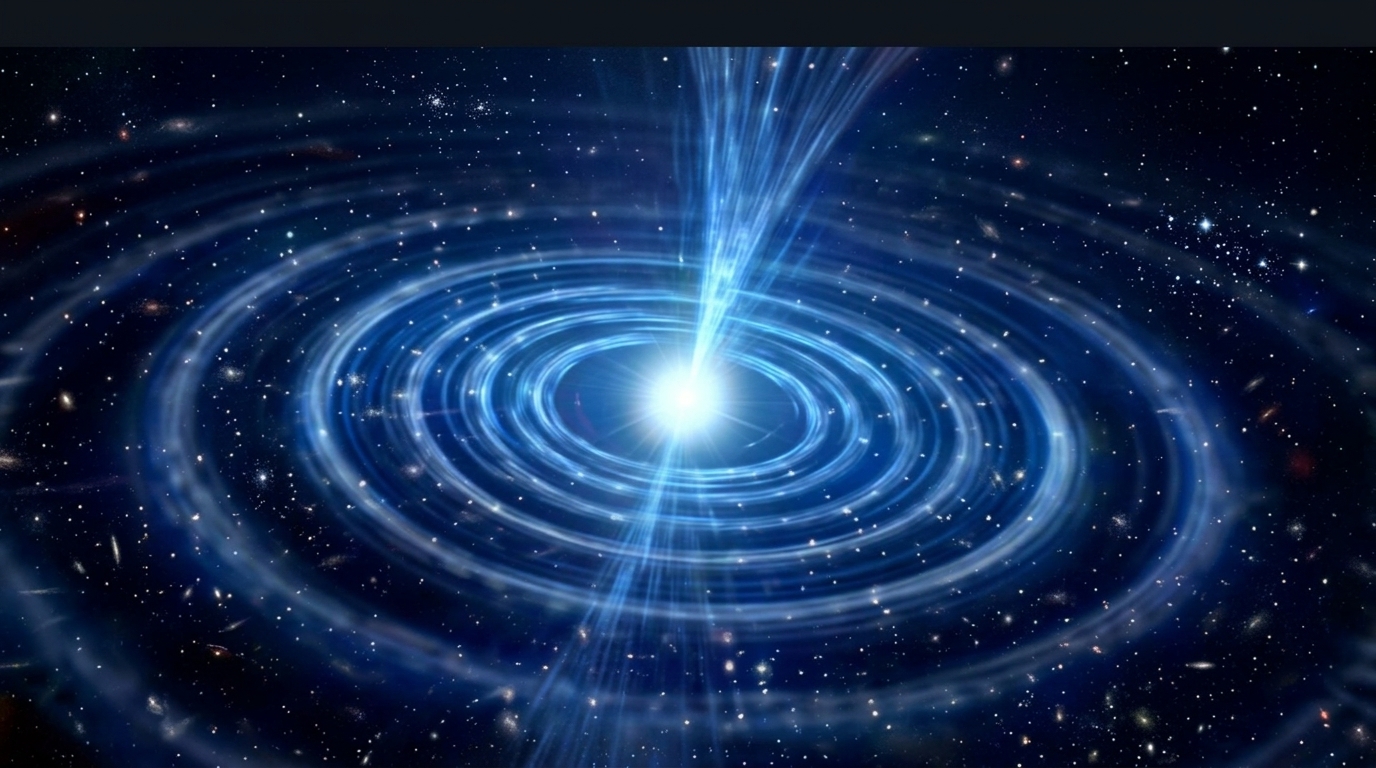
The oldest light reaching our telescopes carries a remarkable record of cosmic history. It comes from a time when the universe was roughly 380,000 years old, long before the first stars illuminated the sky.
Before then, free electrons scattered photons repeatedly through a hot, dense plasma. As the universe expanded and cooled, electrons combined with nuclei to form neutral atoms. Scattering became much less frequent, allowing light to travel freely across enormous distances.
That radiation survives as the cosmic microwave background, or CMB. Its wavelengths have stretched with the expansion of the universe, turning what was once the radiation of a hot early cosmos into the faint microwave glow observed today.
The CMB marks a limit to how directly we can view the early universe using ordinary light. But its patterns preserve evidence of events that happened much earlier. Among the most sought-after traces is a signature of primordial gravitational waves: disturbances in spacetime that could reveal the physics of cosmic inflation.
From quantum fluctuations to cosmic structure
Inflation proposes that the early universe experienced a period of accelerated expansion before the hot conditions described by the conventional Big Bang model.
One attraction of the idea is its explanation for the origin of cosmic structure. In inflationary models, microscopic quantum fluctuations are stretched to enormous scales. These disturbances become the initial variations from which later structure develops.
The fluctuations fall into different categories. Scalar perturbations describe variations associated with density and curvature; tensor perturbations describe gravitational waves. Standard inflationary calculations predict both, although the strength of the gravitational-wave component depends on the model.
Observations of the CMB provide substantial information about the density perturbations. Detecting their gravitational-wave counterpart would supply a different measurement of the inflationary era and help distinguish between competing explanations of its dynamics.
Why gravitational waves can reach further back
Gravitational waves interact with matter far more weakly than photons do. An early universe opaque to light need not be opaque to gravitational waves.
That makes them potential messengers from epochs preceding the release of the CMB. Their survival would connect present-day measurements to physical processes that occurred when the universe was extraordinarily young.
Their signals nevertheless evolve. Cosmic expansion stretches wavelengths, while the changing contents and expansion history of the universe affect how the disturbances develop. Researchers must account for that evolution when reconstructing what an observed signal would imply about its origin.
The search therefore involves predicting a spectrum of relic disturbances and comparing its consequences with observations, rather than treating the waves as an unchanged recording delivered from the past.
Reading the imprint in polarized light
One promising approach is to examine the polarization of the CMB.
Light becomes polarized when its electric-field oscillations acquire a preferred orientation. In the early universe, scattering by free electrons generated polarization where the incoming radiation had an uneven angular distribution.
Gravitational waves can produce the necessary variation. Their effect on the radiation and spacetime geometry can leave a characteristic contribution to the polarization pattern.
Scientists divide that pattern into two mathematical components: E modes and B modes. E modes have an even-parity structure, while B modes have an odd-parity structure often represented by twisting patterns on maps of the sky.
At the simplest, linear level, primordial density perturbations produce E-mode polarization but not B modes. Gravitational waves can produce both. That difference makes B modes a valuable way to search for the tensor fluctuations predicted by inflation.
The competing signals in the sky
A B-mode measurement does not automatically identify primordial gravitational waves.
Gravitational lensing provides one competing contribution. As CMB photons cross the universe, the gravity of intervening structure deflects their paths. This remaps the polarization pattern and converts some E-mode power into B-mode power.
Researchers can estimate part of that contribution using maps of the intervening structure and the CMB itself. Removing it—a process called delensing—helps expose any weaker primordial signal. The BICEP/Keck collaboration identifies improved delensing as an important part of its strategy for reaching greater sensitivity.
Our own galaxy introduces another obstacle. Dust grains emit polarized radiation, and synchrotron emission from energetic electrons also contributes foreground polarization. Measurements at several frequencies help distinguish these signals from the CMB.
The importance of foregrounds became especially clear after BICEP2’s 2014 announcement of a possible primordial signal. A subsequent joint analysis with Keck Array and Planck data found no conclusive evidence for primordial gravitational waves. Galactic dust could explain the apparent excess.
The result established why sensitivity alone is insufficient: a convincing detection must survive careful separation of the different sources contributing to the same sky map.
What the instruments measure
BICEP/Keck experiments observe microwave polarization using telescope receivers at the South Pole. They do not measure passing gravitational waves by comparing the lengths of laser interferometer arms. Instead, they search for the waves’ predicted imprint on ancient radiation.
The successor BICEP Array uses multiple frequency bands to improve sensitivity and foreground separation. A 2026 instrument report describes the continuing development of its high-frequency receiver, whose measurements are particularly important for characterizing dust emission.
Laser interferometers such as LIGO examine a different part of the gravitational-wave spectrum. Their background searches look for correlated disturbances across detectors, which can reveal a collective signal too weak to resolve into individual events.
Such searches can constrain early-universe processes alongside backgrounds generated by later astrophysical sources. An updated LIGO analysis incorporating observations through April 2025 reported no evidence for an isotropic gravitational-wave background and placed tighter limits on its possible strength.
Measuring the strength of inflation
For CMB searches, a central quantity is the tensor-to-scalar ratio, written as r. It compares the strength of primordial gravitational-wave perturbations with that of primordial density perturbations at a specified scale.
An analysis published by BICEP/Keck in 2021, using observations through the 2018 season together with other microwave data, placed an upper limit of r < 0.036 at 95 percent confidence. That was a constraint on the signal, not a detection.
Within standard inflationary assumptions, measuring the tensor amplitude would allow researchers to infer the energy scale of inflation. NASA identifies this as a possible route to investigating energies associated with proposed grand-unification physics. The connection depends on the underlying model; the energy scale has not already been measured.
The contrast with laboratory physics is substantial. The LHC began Run 3 with proton collisions at a centre-of-mass energy of 13.6 TeV. Cosmological observations offer a different route to investigating much higher characteristic energy scales, through the traces those conditions may have left behind.
Building a reliable picture of the earliest universe
The search advances through a combination of cleaner polarization maps, better foreground measurements, improved delensing and independent checks of instrumental effects.
A well-established primordial signal would give researchers a new way to reconstruct the expansion history and test the physical mechanisms proposed for inflation. Its amplitude and variation across scales would help identify which models remain viable.
Even upper limits are productive. They exclude signals that some models predict and narrow the conditions under which inflation could have occurred.
The cosmic echoes physicists seek are faint, but the questions they address are concrete: how the early universe expanded, which disturbances it produced, and how those disturbances became the initial conditions for the cosmos we observe.