Dark Matter Matrix: Scaffolding the Unseen Universe
Gravitational lensing and galaxy motions reveal how unseen matter shapes cosmic structure, from extended galactic halos to the filaments of the cosmic web.
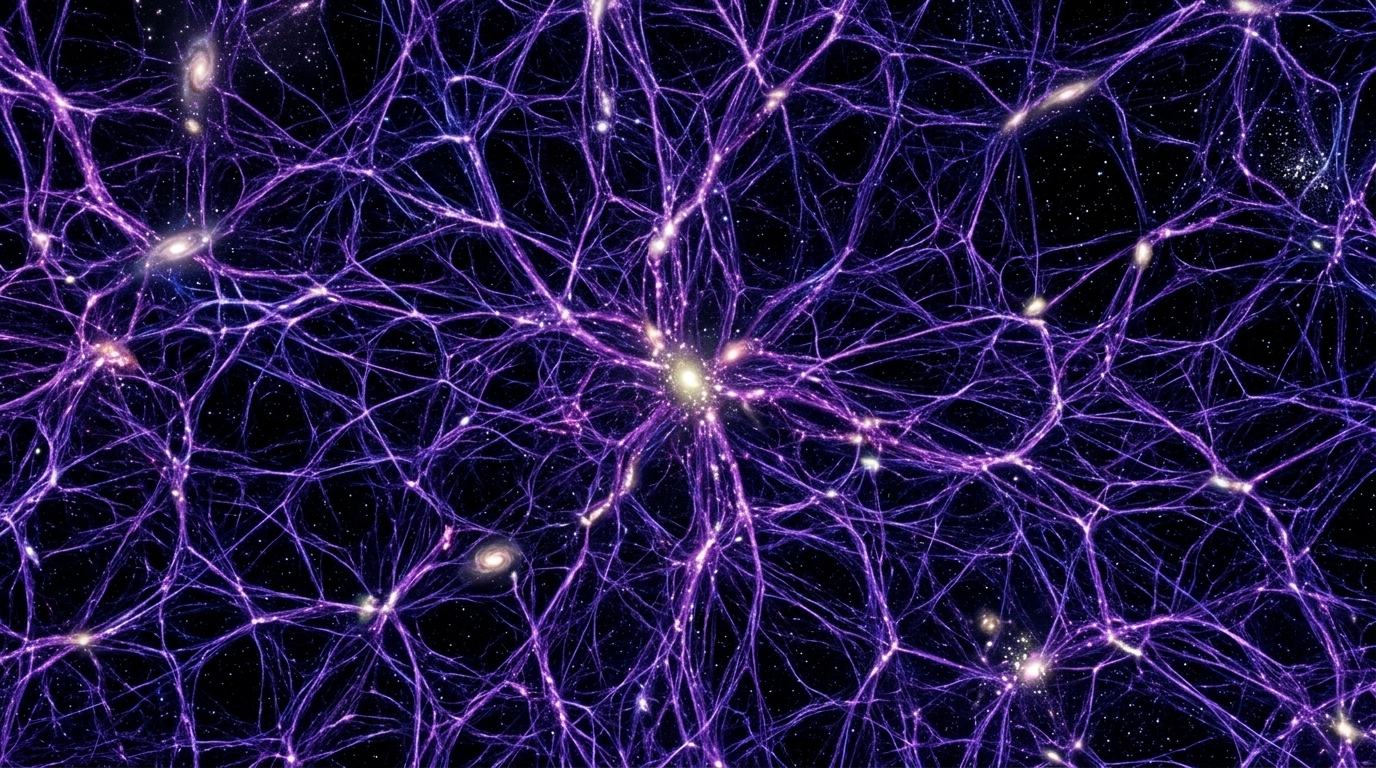
The luminous universe traces only part of its gravitational structure. Stars reveal galaxies, and hot gas illuminates galaxy clusters, but neither accounts for all the mass inferred from their motions and the bending of background light.
Within the standard cosmological model, ordinary matter contributes roughly 5% of the universe’s present-day energy budget, dark matter about 27%, and dark energy approximately 68%. Ordinary matter includes stars, planets and extensive reservoirs of gas, much of which is difficult to observe. Dark matter represents about 85% of the total matter content.
These proportions come from fitting a cosmological model to observations, rather than from galaxy rotation alone. Together, measurements of cosmic structure, gravitational lensing and the early universe indicate that most matter behaves differently from the atoms familiar to us.
Galactic Motion and the Missing Mass
One of the strongest clues comes from the rotation of spiral galaxies.
For an approximately circular orbit in a spherical mass distribution, orbital speed depends on the mass enclosed within that orbit. If most of a galaxy’s mass were concentrated within its bright central regions, speeds sufficiently far beyond those regions should decline with distance.
Instead, many galaxies exhibit approximately flat rotation curves across substantial portions of their outer disks. Stars and gas continue moving faster than the observed distribution of ordinary matter can readily explain under conventional gravity.
Vera Rubin and her collaborators helped establish this discrepancy through systematic observations in the 1970s. Their work extended an older missing-mass problem: in 1933, Fritz Zwicky had inferred additional mass from the motions of galaxies in the Coma Cluster.
In the dark-matter interpretation, galaxies occupy extended halos whose mass continues accumulating well beyond the brightest stellar regions. These halos need not be perfectly spherical, and their density profiles vary. The essential inference is that the gravitational mass distribution extends farther than the visible light suggests.
Gravitational Lensing as a Mass Probe
General relativity provides an independent way to investigate that distribution. Matter alters spacetime geometry, changing the paths followed by light from more distant objects.
Strong gravitational lensing can produce elongated arcs, multiple images or Einstein rings. Weak lensing produces much smaller distortions, detectable statistically across large populations of background galaxies.
Because galaxies already have varied intrinsic shapes, an individual distorted image rarely supplies a complete measurement. Researchers look for coherent patterns in many images, accounting for telescope optics, measurement noise and uncertainties in source distances.
Lensing responds to all gravitating matter along the line of sight. It therefore supplies a mass estimate without requiring that the material emit light. Comparing this inferred mass with independently measured stars and gas helps establish the amount and distribution of dark matter.
Combining lensing measurements with source-distance information also allows researchers to investigate how the mass distribution changes across cosmic time.
When Mass and Gas Separate
Colliding galaxy clusters provide a particularly revealing test.
In the Bullet Cluster, observations show that the hot, X-ray-emitting gas is displaced from the principal mass concentrations inferred through gravitational lensing. During the collision, the gas experienced strong interactions and slowed, while the galaxies passed through more readily.
The separation between the gas and the inferred mass supports a substantial component that behaves comparatively collisionlessly. It is difficult to explain the gravitational pattern using the observed ordinary matter alone.
This evidence constrains dark matter’s behavior without identifying its microscopic composition. A lensing map reveals where gravity requires mass; it does not reveal which particle, if any, supplies it.
Building the Cosmic Web
On larger scales, matter forms a network of dense nodes, extended filaments, sheets and relatively empty voids: the cosmic web.
In the standard picture of structure formation, small initial density variations grow through gravitational instability. Denser regions attract additional material, and their evolving gravitational fields channel matter into increasingly pronounced structures.
Dark matter supplies most of the matter driving this growth. Galaxies develop within its halos, while galaxy clusters assemble near major intersections of the surrounding network.
Ordinary matter participates in the same gravitational evolution but also responds to pressure, radiative cooling, magnetic fields and energy released by stars and accreting black holes. These processes change where gas collects and where stars form, making the luminous universe a complex tracer of the underlying mass.
Simulations model this joint evolution and predict structures that can be compared with galaxy surveys and lensing measurements. The cosmic web is dynamic: halos merge, material flows along filaments, and voids expand relative to their denser surroundings.
What “Cold” Dark Matter Means
The widely used cold-dark-matter model assumes that dark matter moved slowly enough during the relevant stages of structure formation to preserve density variations on small scales.
Particles moving rapidly can travel out of growing concentrations, smoothing those variations through a process called free streaming. Their motion therefore affects which structures can form and how those structures develop.
“Cold” describes this cosmological behavior rather than a requirement that dark matter be motionless or literally near absolute zero. Nor does it identify a particular particle.
Candidates include weakly interacting massive particles, or WIMPs, and axions, whose proposed masses and interactions differ greatly. Other possibilities remain under investigation. Gravity establishes the observational problem, while particle models propose additional interactions that experiments might detect.
The number of dark matter particles crossing a given area would depend on their mass and velocity distribution. A claim that precisely billions pass through a person each second therefore assumes a particle model that has not been established.
Searching Beneath the Surface
Direct-detection experiments seek the small energy deposits that dark matter might produce when interacting with ordinary material.
LUX-ZEPLIN, or LZ, operates a liquid-xenon detector deep underground at the Sanford Underground Research Facility. It measures light and electrical signals from interactions within the xenon, using their characteristics to distinguish potential nuclear recoils from backgrounds.
SuperCDMS uses a different approach: silicon and germanium crystals cooled to extremely low temperatures. Its sensors measure tiny lattice vibrations and, depending on the detector configuration, ionization signals. Sensitivity to very small energy deposits makes these detectors useful for investigating lower-mass candidates.
Underground locations reduce interference from cosmic rays, while shielding, material selection and detailed background models help distinguish rare signals from ordinary radiation. An unexplained event still requires statistical analysis and independent scrutiny before it can support a discovery.
Structure, Expansion and the Remaining Questions
Dark matter helps determine how cosmic structures grow. Dark energy, in the standard cosmological model, contributes to the accelerated expansion that influences this growth on the largest scales.
Mapping both the distribution of matter and its evolution allows surveys to test these effects together. Euclid combines galaxy clustering and gravitational lensing to investigate the relationship between expansion, structure formation and gravity.
The invisible scaffolding is therefore more than a static map of hidden mass. Its changing structure records the universe’s history. Explaining its composition would connect that history to fundamental physics, revealing what supplied most of the matter from which galaxies and clusters assembled.