The Fabric of Reality: Unraveling Quantum Entanglement and Spacetime
A deep dive into how cosmic structures and non-local subatomic interactions reveal a unified architectural layout for our universe.
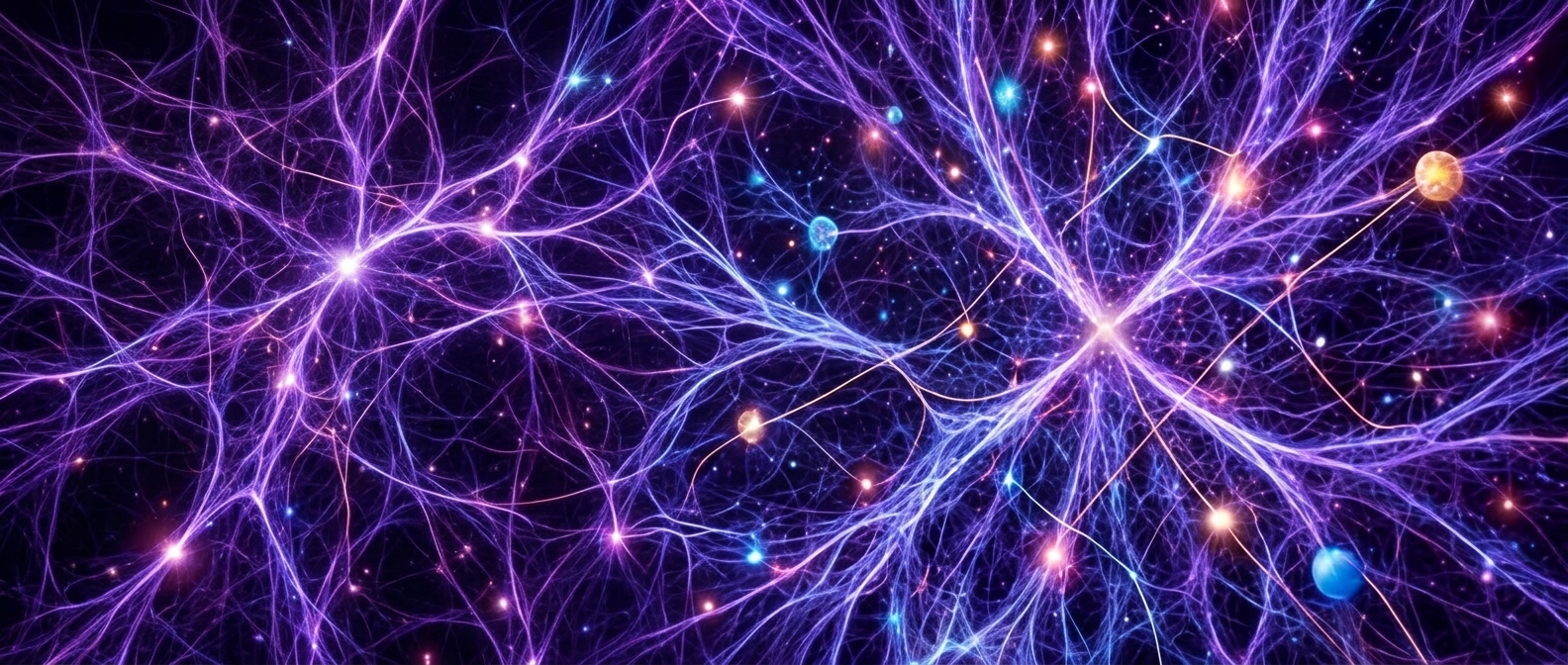
Space seems like the most basic feature of reality. Objects occupy locations, distances separate them, and events unfold through time. Yet some approaches to quantum gravity suggest that this familiar structure may emerge from something deeper: the quantum relationships between physical systems.
That possibility brings together two subjects that initially seem far apart. General relativity describes gravity through the geometry of spacetime. Quantum entanglement describes correlations that cannot be explained by treating the participating systems as independent objects with ordinary, locally determined properties.
In certain theoretical models, those correlations have a geometric interpretation. Changing the entanglement changes the spacetime described by the model. The question is whether this mathematical connection can help explain why space exists—and eventually illuminate the universe we actually inhabit.
Two successful theories, one unfinished picture
Einstein’s general relativity describes spacetime as dynamic. Matter and energy influence its curvature, while that curvature influences the motion of matter and light. This framework explains phenomena ranging from planetary orbits to gravitational waves.
Quantum theory describes physical systems through states that determine the probabilities of measurement outcomes. Its applications extend well beyond individual particles: atoms, materials and large collections of interacting particles all require quantum descriptions.
The difficulty arises when spacetime itself must be treated quantum mechanically. Physicists can calculate quantum corrections to gravity at low energies using effective field theory. What remains unresolved is a complete description applicable to extreme situations where the familiar approximation of smooth spacetime may fail. Black holes and the earliest stages of cosmic history make that problem especially consequential.
What entanglement actually connects
Two systems are entangled when their joint quantum state cannot be described simply as a combination of independent states for each system.
Consider a suitably prepared pair of photons sent to distant laboratories. Each laboratory measures polarization. The individual outcomes are unpredictable, but the relationship between the outcomes depends on the shared state and the measurement settings.
This is more than finding matching instructions inside two envelopes. Ordinary hidden instructions, constrained by the assumptions of Bell’s theorem, place limits on the correlations the laboratories can observe. Quantum mechanics predicts that appropriate experiments can exceed those limits.
In 2015, an experiment involving electron spins separated by 1.3 kilometres violated a Bell inequality while addressing the major detection and locality loopholes together. Such experiments provide strong evidence against local hidden-variable explanations satisfying the relevant assumptions. They do not, by themselves, settle every philosophical question about measurement or reality.
A correlation is not a faster-than-light message
Entanglement does not give either laboratory control over the other laboratory’s results. One observer cannot choose an outcome and thereby send a readable message to the other.
To establish the correlation, the observers must compare their records through an ordinary communication channel. That comparison remains subject to relativity’s speed limit.
Quantum teleportation illustrates the distinction. It transfers an unknown quantum state using shared entanglement together with classical information. Without the classical message, the receiver cannot complete the procedure. It therefore provides no shortcut around the speed of light.
Descriptions of entanglement as an instantaneous conversation can obscure what experiments actually demonstrate. The remarkable result is the structure of the correlations, not a detected message travelling between the particles.
The holographic clue
One of the most influential developments in quantum gravity came from Juan Maldacena’s 1997 proposal of the AdS/CFT correspondence.
The correspondence relates certain gravitational theories in anti-de Sitter spacetime, abbreviated AdS, to quantum field theories associated with their lower-dimensional boundary. In this proposed dual description, the boundary theory does not contain gravity in the same form, yet it encodes a gravitational spacetime.
This is the sense in which the description is holographic: a theory in fewer dimensions can encode physics in a spacetime with an additional spatial dimension. Of course, it does not mean that the universe is an optical projection.
The correspondence provides a powerful setting for investigating how geometry could arise from quantum physics. Its importance lies in the detailed mathematical relationship between the descriptions, rather than the visual metaphor alone.
Turning quantum relationships into geometry
In 2006, Shinsei Ryu and Tadashi Takayanagi proposed a particularly striking connection within holographic theories.
Their prescription relates the entanglement entropy of a boundary region to the area of a particular minimal surface extending into the gravitational spacetime. Entanglement entropy measures how a region is correlated with its complement; here, that quantum quantity is linked to a geometric area.
The relationship applies under specified theoretical conditions. It is not a formula for calculating the distance between any two entangled particles in a laboratory. Nevertheless, it gives physicists a concrete way to connect quantum correlations with spatial structure.
Mark Van Raamsdonk explored the consequences in a 2010 essay. In the examples he examined, reducing entanglement between parts of the underlying quantum system caused corresponding spacetime regions to pull apart and the connection between them to narrow. Removing the entanglement could correspond to disconnected geometries.
A knitted fabric offers a useful analogy. Its connected structure depends on how its threads are joined. Alter those connections and the fabric changes; remove enough of them and it separates.
The analogy has limits. Quantum information is not literal yarn, and entanglement is not a physical thread running through an already-existing space. The intriguing possibility is that the relationships help determine the space itself.
ER = EPR and the wormhole connection
In 2013, Maldacena and Leonard Susskind proposed ER = EPR, connecting Einstein-Rosen bridges with Einstein-Podolsky-Rosen entanglement.
The strongest examples concern particular entangled black-hole states with a gravitational description. In those settings, a bridge through the interior can represent the entanglement between the systems. The familiar bridge is non-traversable: it does not provide a route for communicating between the two exterior regions faster than light.
The authors also proposed extending the connection to more general entangled systems. That broader claim is conjectural. It does not establish that every entangled electron is attached to another electron by a tiny, classical tunnel.
Even within the black-hole examples, the precise quantum state matters. Entanglement is not a single number that specifies every feature of a bridge. Different states can have similar amounts of entanglement while corresponding to different geometrical structures.
What this means for our universe
These connections are compelling because they provide more than an attractive metaphor. Within their theoretical settings, they offer mathematical relationships that researchers can calculate and investigate.
But a working relationship in a model is not automatically a description of the cosmos.
The best-understood holographic examples involve anti-de Sitter spacetime. Our expanding universe is not simply one of those examples. Establishing an equally complete description appropriate to cosmology remains a substantial challenge.
Likewise, the emergence of spatial connectivity does not automatically explain the emergence of time, account for every gravitational phenomenon, or establish that gravity is merely a thermodynamic effect. Those are further questions, requiring further arguments.
Laboratory demonstrations of entanglement establish quantum correlations. They do not independently establish that spacetime emerges from those correlations. The distinction between experimental evidence and a proposed interpretation is essential to understanding what this research has achieved.
A deeper question about distance
The possibility of emergent spacetime changes the question physicists ask.
Instead of assuming that quantum systems occupy a pre-existing geometry, they can investigate which quantum relationships permit a smooth geometry to appear—and what happens when those relationships change.
That approach has not supplied a finished blueprint for reality. It has supplied something valuable: specific theoretical settings in which information, entanglement and geometry can be studied together.
The fabric of reality may turn out to have a structure very different from the one our senses suggest. Understanding it will require keeping the bold ideas and the evidential boundaries equally clear.